
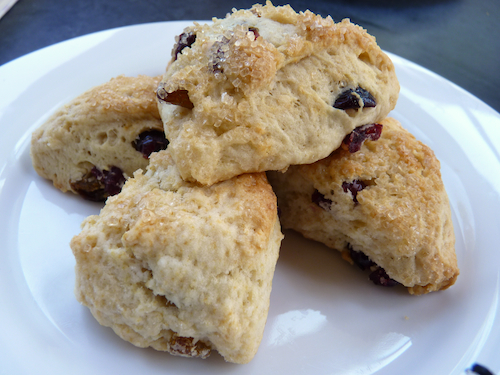
Virtually everyone that knows me has eaten these scones. And reached for another. And asked for the recipe. This is may be the best recipe I have – cream scones that are moist, tender and are a breeze to make. Because the recipe uses cream and no butter, it’s nearly as easy as a mix. Just toss ingredients in a bowl and stir. A brief knead to mop up extra flour, and that’s it. You don’t even need to crack an egg (a real find for anyone with egg allergies).
This recipe originally came to me from my amazing friend Lisa (she of the banana bread and the chicken adobo). Years later I was excited to discover the source as The Breakfast Book

[Added December 22, 2011: I realized later that Marion’s recipe leaves little room for error. Since the average cook is more likely to have extra flour than extra cream on hand, I think it’s safer to start with Lisa’s recipe and add more flour as necessary.]
So here’s the recipe for melt-in-your-mouth dried fruit cream scones that may change your life.
Dry ingredients (note that I’m making a double recipe here).

Add dried fruit (I almost always use cranberries and golden raisins, but of course you could make this with nuts, chocolate chips, or any dried fruit you like).
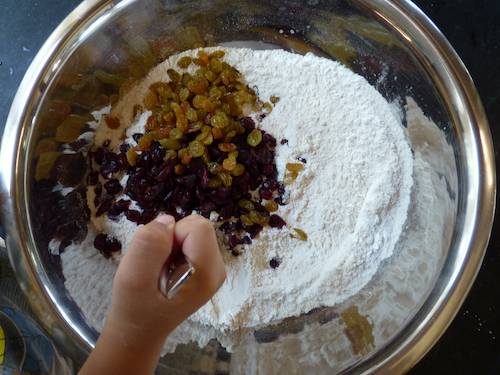
Add cream (save the measuring cup for later).
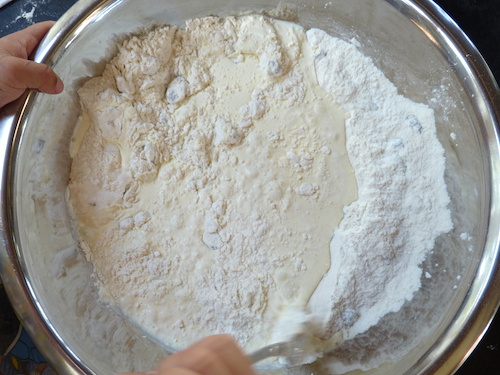
Mix until dough gets too stiff to stir.
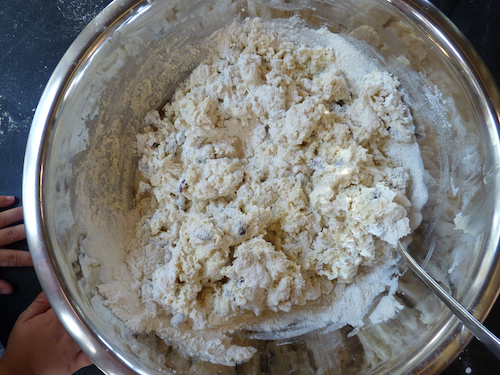
Use hands to bring dough together and knead to incorporate remaining flour (my camera got very sticky here). Add more flour, a bit at a time, until dough is soft, smooth and no longer sticky on the surface.
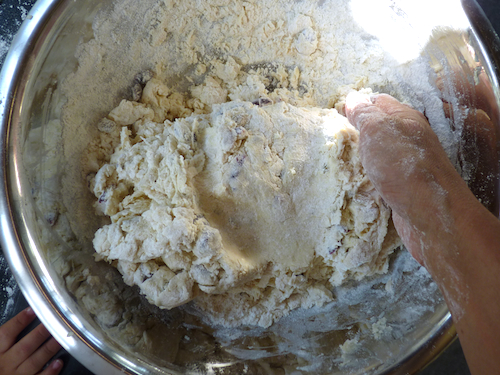

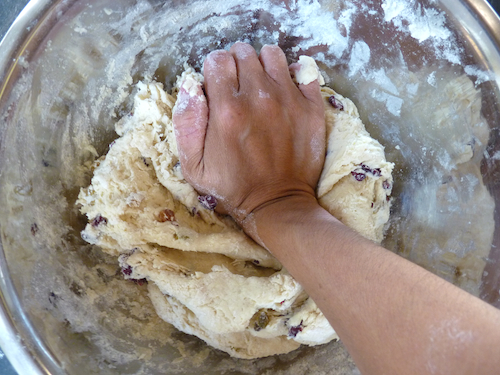
You can make the scones any way you like (eg roll it out and stamp out rounds with a biscuit cutter, or cut triangles). Marion’s recipe calls for a pressing the dough into a 10″ round and cutting it into 12 wedges. I prefer to make 24 smaller, fatter wedges.
Divide ball of dough in half and then half again. You will have four small rounds. Since I made a double recipe, the large round here is the size of the single recipe, and the four small rounds show what the large round looks like when divided.
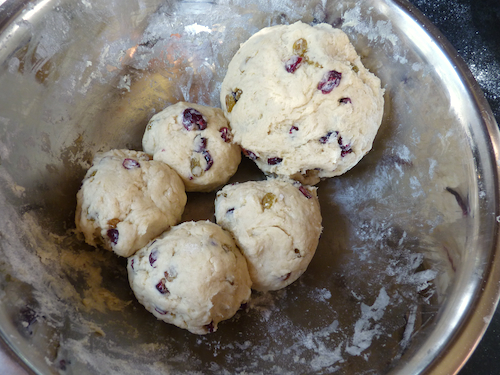
On a lightly floured surface, press each round into a thick disc. I like to put down a sheet of waxed paper (much easier than making sure there are no stray crumbs on my counter).
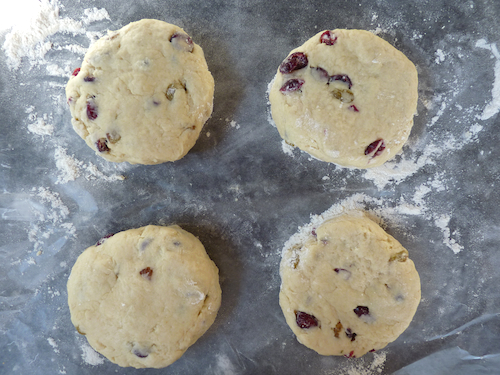
Coax a few drops of cream out of the measuring cup on top of each disc (Marion’s recipe calls for melted butter, but this is my lazy variation).
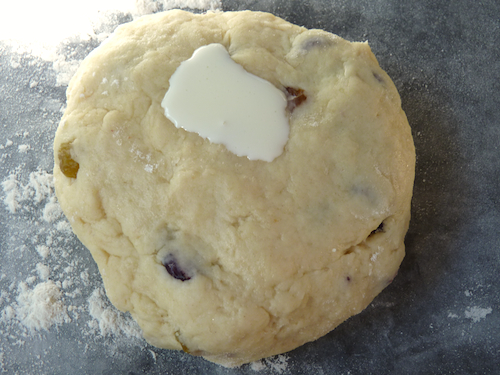
Spread cream.
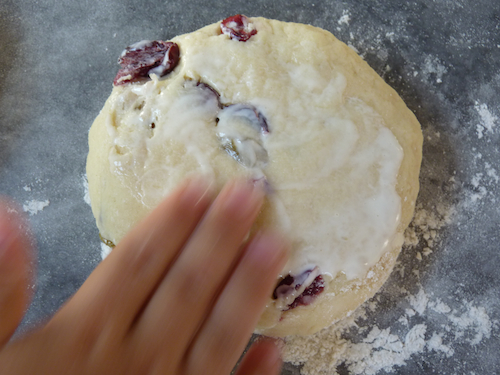
Sprinkle with sugar (I like the raw kind for the crunch, but regular will do as well).
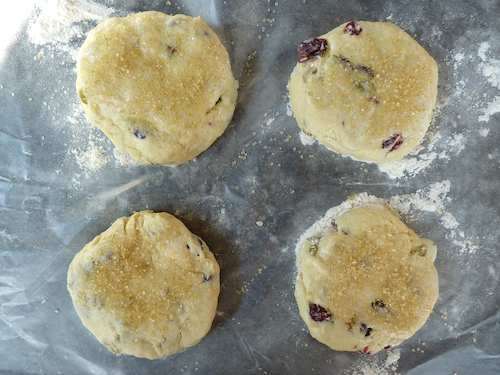
Cut each disc into six wedges. I use a pastry scraper (this is my 4 year old’s favorite part).
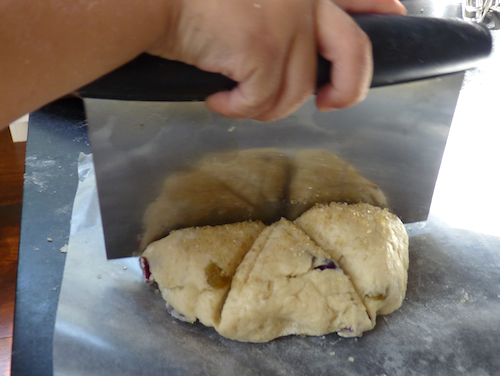
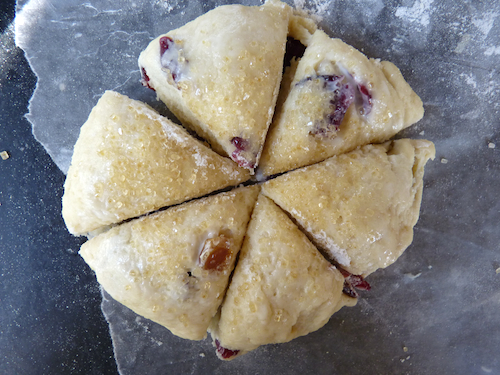
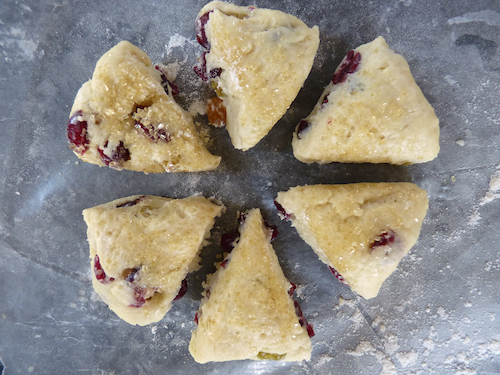
My lazy approach is to squeeze all 24 on one jelly roll pan. Baking purists wince away!
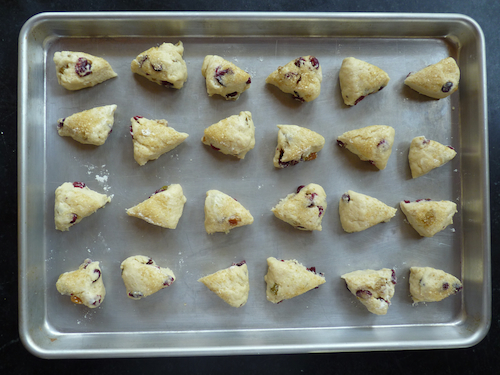
Crowded but perfectly happy.

Hot from the oven, these scones melt in your mouth. My teenage nephew once ate a dozen (maybe more!) in one sitting. In any case, it’s a good thing these are so easy to make fresh, because it’s not often we have any left by the end of the day.
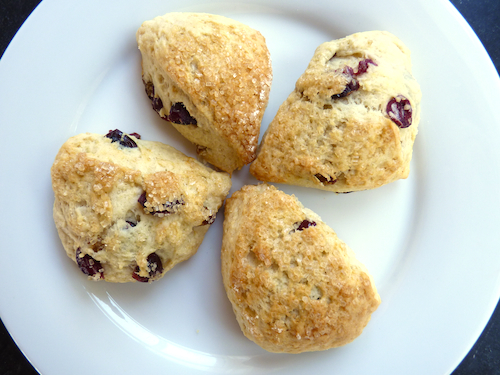
Dried fruit cream scones
Adapted from The Breakfast Book by the great Marion Cunningham. The best scones you’ve ever had. Moist, tender and a breeze to make.
Ingredients
- 2 cups flour (270g/9.5 oz), plus additional flour for kneading
- 1/4 cup sugar
- 1 tablespoon (3 teaspoons) baking powder
- 1/2 teaspoon salt
- 1/2 cup dried cranberries or other dried fruit (chopped if large)
- 1/4 cup golden raisins
- 1 1/2 cups heavy cream
Sugar topping
- Cream or melted butter for brushing on scones
- 2 tablespoons sugar (raw/coarse sugar gives a nice crunch if you have it)
Directions
- Preheat oven to 375 degrees F.
- Combine flour, sugar, baking powder and salt in a large mixing bowl. Mix with a fork.
- Add cranberries and raisins. Mix.
- Pour in cream (but keep the measuring cup for later) and mix with fork until dough becomes thick and hard to stir.
- Using hand, knead the sticky dough in the bowl, turning and pressing the dough to incorporate the flour. Add more flour if you need it, a tablespoon at a time, until surface of dough is smooth, soft and no longer sticky.
- Split the ball in half to form two smaller balls. Then split each half again in two smaller balls. You will now have four small balls of dough.
- On a lightly floured surface, slightly flatten each ball into a thick disc about 5 inches in diameter.
- Pour a few drops of cream from the empty measuring cup on each disc and use fingers to spread cream evenly over the top. Sprinkle with sugar.
- Cut each disc evenly into six wedges. Place on ungreased baking sheet, leaving some room in between for scones to rise as they bake.
- Bake 15 minutes, or until scones are golden brown.
Makes 24 small scones.
Notes
- Substitute any dried fruit or nuts you like. Chop nuts and large fruit, eg dried apricots.
- I don’t recommend substituting fresh fruit for dried – I’ve tried making these with frozen blueberries, and oddly enough the water moisture of the fresh fruit dilutes the creamy moistness of this scone dough. The frozen blueberry scones were good, but the dried fruit scones are life changing.
- If you want to use a pint (2 cups) of cream, here are the other proportions: 2 2/3 cups flour, 4 teaspoons baking powder, 2/3 teaspoon salt, 1/3 cup sugar, 2/3 cup cranberries, 1/3 cup golden raisins, 2 cups heavy cream. Divide into six balls. Makes 36 small scones.
- If you want to use a quart (4 cups) of cream, here are the other proportions: 5 1/3 cups flour, 8 teaspoons baking powder, 1 1/3 teaspoons salt, 2/3 cup sugar, 1 1/3 cup cranberries, 2/3 cup golden raisins, 4 cups heavy cream. Divide into 12 balls. Makes 72 small scones.
Here’s the link to a printable version.






I have made these for years from Marion’s book, so much so that the spine of the book is cracked and opens up immediately to that page. She credits them to James Beard who originated them in print. I have never had a bad biscuit/scone using this recipe. In her original book she dips them in melted butter. I always have lots of heavy cream on hand so I can make these at the drop of a hat or when company comes by. Enjoy as these are great.
thanks, marilyn! nice to meet another fan of the most amazing scones ever. i keep meaning to make more recipes from marion’s book, but the scones are always calling… =)
I made this twice already and it is soo good. This is the only thing I can bake without it turning out funky. I didn’t have heavy cream both times I made it, so I just used 1 cup half and half milk mixed with half cup of melted margarine, and the second time I used butter instead, but they both turned out good. 🙂
hi julie – once you make these scones, it’s hard to stop! awesome to know it works with your variations – thanks for sharing.
I’ve used a similar recipe for years, but nearly panicked when I got volunteered to make them for a hundred people at a special tea this Sunday; I’m terrible at math, you see, and my recipe only makes 8-12 scones at a time! The additional notes at the bottom of your post were incredibly helpful. Thank you very much for taking the time to do the calculations, and for sharing them.
hi dana – i’m glad my math helped you! i refer to those calculations all the time too. scones are just about the only time i use cream, so most often i go ahead and use the full pint.
I’ve been on the quest for the perfect scone recipe, and today the quest stops! This is the easiest scone recipe I’ve ever tried plus the best! I made it exactly as the recipe says except I added the melted butter on top instead of the cream. I also made jalapeno/sharp cheddar cheese scones by omitting the sugar and adding the peppers/cheese and sprinkling parmesan cheese on top of the melted butter; they were awesome! I have a scone pan so it’s so easy to just whip them up on a moment’s notice! I plan to try cinnamon chip, chocolate chip and other dried fruits for all kinds of scones. Thanks so much for this perfect recipe!
hi carol – i have made these scones a million times but never got around to making a savory version. i am now craving jalapeno cheddar scones, thanks for the inspiration! this really is the best scone recipe ever, marion cunningham is the bomb. thanks so much for sharing back!
Well, I made cinnamon chip scones last night! They are the best I’ve ever had! A friend and I have been on a quest; we have a friend who makes delicious cinnamon scones but won’t give us the recipe so we’ve been researching recipes trying to figure it out. Your recipe made with cinnamon in the dough and then cinnamon chips instead of the dried fruit was way better than the ones we were trying to copy! This is the ONLY scone recipe I will ever use! It is so easy and so delicious; and I know the trick is to used dried fruits never fresh or frozen and/or chips/nuts. I’m planning to try culinary lavender with lemon extract! Thanks again for sharing such an awesome recipe!
hi carol – thanks for sharing your success story! cinnamon chip sound so good. and lavender/lemon should be amazing too! you really can’t go wrong with this recipe, it’s the ultimate! and of course such a bonus that it is so easy too. =)
I forgot to mention that I always put melted butter on my scones, then the sugar or in the case of the cinnamon ones, I used cinnamon/sugar. My next question for you: How would I make pumpkin scones? Do I replace some of the cream since the pumpkin would add more moisture? I think they would be amazing! Thanks for your help! Carol
hi carol – pumpkin sounds like a great idea! i think you can substitute pumpkin puree 1:1 as a fat (in this case, cream) substitute. taking away some of the fat/cream will change the texture of the scone too. so you might want to try substituting for 1/3 or 1/2 of the cream (1/2 to 3/4 cup of the 1 1/2 cups of cream in the recipe), and add a teaspoon or two of pumpkin pie spice (mostly cinnamon, with bits of nutmeg, ginger and cloves). let me know how it goes! i wish i could be there to sample. =)
I made scones for the first time ever and I think I failed ever so slightly at them! I don’t think I used enough flour and made them way too big. I have an excuse to make them again, however! I won’t give up. Mine look like giant chocolate chip biscuits.
hi danielle – yes, they do grow during baking! but giant chocolate chip biscuits sound pretty awesome. =)
You’re right these are life changing.
I used half and half instead of heavy cream because its what I had on hand. (Since I put it in my coffee everyday I buy it by the quart and then use it in cooking.) They definitely could’ve been a little richer, but they still melt in my mouth. Thanks for the great recipe!
oh LLB, if you think they’re life-changing with half-and-half, you’ve GOT to try them with heavy cream! half milk is no substitute for all cream, esp when there’s no butter. the cream is everything! but i’m happy they were still good with half-and-half – thanks so much for sharing. =)
Without a doubt, these are the best scones ever! I have thrown away all my other recipes! I made some with pumpkin, replacing 1/2 of the amount of cream for pumpkin; however I ended up adding more cream so it wasn’t exactly an even amount. I put golden raisins, pecan chips, and a handful of cinnamon chips in the scones (along with pumpkin pie spice) and made a frosting of butter, powdered sugar and a little cream to top them. They are outstanding! Any time I see the scone recipes with cold butter in them, I just scoff and think to myself, “they don’t know how to make scones.” This is the only recipe you will ever need for scones: I’ve used every type of dried fruit and chips and then make a frosting to go with the flavors I’ve used. Love this recipe!!!!
I made these for 15 years and lost the recipe in a big move and the resettling into a new house. Looked everywhere for this recipe in the house and online and was so thrilled to find it on your blog.
My original recipe was for lavender scones. No fruit or nuts, just a 1/4 tsp of crumbled dried culinary lavender in the dough and a light sprinkling of lavender with the sanding sugar on top after the scones have been brushed with the residual cream in the measuring cup.
Makes the whole house smell like lavender when baking and is a real treat with a little lavender honey! Makes great plain biscuits, too, just reduce the sugar. Thanks to LLB for the 1/2 and 1/2 tip.
Thanks again for the basic recipe and for the jalapeno/cheddar tip, too. Made my day!
hi catpainter67 – i love the lavender idea, thanks so much for sharing! and i am so glad you found the recipe here – it’s such a gem.
Thank you so much for this recipe! I am planning on making these this weekend for my sister’s baby sprinkle. Do you know if I can make them or at least the dough the night before?
hi alison – the scones are really best fresh, so i would say make the dough the night before. probably easiest to form the discs of dough, wrap in plastic wrap and refrigerate. then the next day you can cut and bake. good luck, and congrats to your sister!
This is my new favorite scone recipe! The cream created the exact consistency I prefer. After making them a few times with varying ingredients, my most popular are a “cinnamon roll scone”! I added 2 tsp. cinnamon and 2 Tbs. brown sugar to the dry ingredients then topped them with a simple glaze after baking. Perfection. Thanks for sharing such a great recipe!!
hi steph – yay! marion cunningham is the scone master. i love your cinnamon roll scone – my friend just did a cinnamon version too and loved it. i need to try it! thanks for sending inspiration back. =)